
4 hours ago
EDGE Interview: Why Scrooge Still Speaks to Us: CSC’s Steven Maler On Storytelling, Service, and the Power of Transformation
Steve Duffy READ TIME: 3 MIN.
If you are near Boston, step into the magic of Victorian England and rediscover the heart and soul of the holiday season! Commonwealth Shakespeare Company returns for another magical season at Boston’s historic Emerson Cutler Majestic Theatre with its stunning production of Charles Dickens’ “A Christmas Carol”—a timeless story of redemption, generosity, and the power of human kindness. Beloved Boston actor Will Lyman (CSC’s King Lear) returns as Ebenezer Scrooge, the curmudgeonly miser whose cold heart is thawed by a trio of mysterious spirits on one fateful Christmas Eve.
This enchanting adaptation by award-winning writer/director Steve Wargo brings Dickens’ classic to vivid life. Described as “a musical feast” (The Boston Globe), it is brimming with traditional 19th-century carols arranged by Dianne Adams McDowell (A Gentleman’s Guide to Love & Murder, Starmites). With direction by CSC Founding Artistic Director Steven Maler and musical direction by Dan Rodriguez, this “heart-filled new tradition” (WGBH) is sure to delight audiences of all ages.
Make Charles Dickens’ “A Christmas Carol” part of your holiday tradition—and experience the story that continues to warm hearts, year after year.
We sat down with CSC Founding Artistic Director Steven Maler to discuss the heart of this production and why Dickens’ message still resonates today.
EDGE: How do you connect personally to Charles Dickens’ A Christmas Carol?
MALER: That’s a great question. For me, I’ve always loved big, epic narratives—stories that explore scale, emotion, and the forces that shape humanity for better or worse. Shakespeare is steeped in that tradition, and at CSC, we embrace it fully. With this piece in particular, what I find most rewarding—especially now, as we’re deep in rehearsals—is its generosity and its call to action. It urges us to be better citizens, better members of our community, and to recognize our connection to one another. That’s deeply gratifying to me. So much of my work with Commonwealth Shakespeare Company has been about contributing to society and doing our part to make the world a better place. This narrative reminds us—especially during the holiday season, when life can feel chaotic—that there’s something bigger at stake: our responsibility to our fellow human beings. That’s what truly matters. In these challenging times, that message feels more urgent and necessary than ever. Being inside this piece has been satisfying because it reinforces the idea of service to the community. It asks us to reflect on that responsibility, both in the small details of daily life and in the larger picture.
EDGE: What drew you to Steve Wargo’s adaptation of A Christmas Carol?
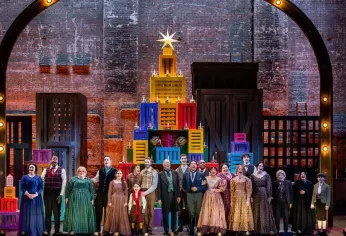
SM: We explored many different adaptations while preparing for this production. One of our board members, an internationally recognized Dickens scholar, joined our think tank, along with our artistic team and me, as we reviewed various versions. While several had appealing qualities, none felt quite right for us—until we landed on Steve’s adaptation. What I love about Steve’s work is that it’s deeply faithful to Dickens. He doesn’t try to be clever or impose a modern context; he lets the material speak for itself. At the same time, Steve shares my passion for theater-making and storytelling. His framing device—a troupe of players telling the story—embraces narration and reveals the mechanics of storytelling, which is incredibly exciting from a directing and staging perspective. Another standout feature of this adaptation is the integration of music. Steve and Dianne Adams McDowell have collaborated for years to weave music into the narrative in a way that feels organic and powerful. The songs aren’t interruptions; they advance the story, much like in a great musical or opera. This approach brings iconic seasonal music into the piece while keeping it dramatically compelling. The result is a production that feels expansive and theatrical, with exceptional singing under the direction of Dan Rodriguez and choreography by John Lam, formerly of Boston Ballet. It’s not a traditional musical—we never sing Dickens’ words—but it has the energy and scale of one, with big production numbers and dance sequences. For me, this adaptation fully embraces the art of theater-making, combining music, dance, and storytelling into a rich, dynamic experience.
Source: CSC
EDGE: Tell us about working with musical director Dan Rodriguez to integrate songs into the narrative.
SM: He’s been an incredible partner. Last year was actually the first time I worked with him on this project. I’ve done some opera here and there, but not as much musical theater, so our paths hadn’t crossed much before. From the start, though, it was an immediate, seamless partnership. We share the same vision for how music functions in this piece, and his ability to work with such a wide range of singers is extraordinary. The baseline for this cast is strong, but we also have exceptional singers—artists who perform on major opera stages worldwide. Dan meets those high-level performers one-on-one while also working with kids who aren’t trained singers and actors like Will Lyman, who sings very little in his usual work. Watching him navigate that spectrum with ease has been inspiring. His attention to detail is remarkable, which is critical when you have 16 to 18 singers on stage, and the only accompaniment is Dan himself on piano. He’s not just the musical director—he’s in the piece, playing and acting as part of the narrative. Audiences walk away thinking there must have been a full orchestra, but it’s just him and these extraordinary voices. The harmonies, orchestrated by Dianne, are complex and demanding, but when they come together, the sound is glorious. It takes immense effort to make it feel effortless, and Dan approaches that challenge with joy, rigor, and fun—the same way I like to approach the work. It’s been a privilege to collaborate with him.
EDGE: How did you guide Will Lyman, who is playing Scrooge, to find depth beyond the stereotype?
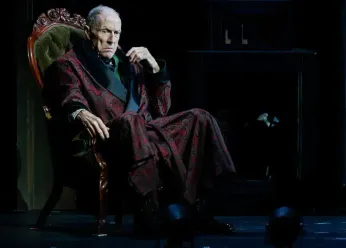
SM: Will and I have worked together for many years. He was part of the early productions of Commonwealth Shakespeare Company on the Common when we were just starting out. His saying yes to those early projects sent a powerful message—that this was a serious company with a vision, committed to depth, complexity, and theatricality. So when we began thinking about this project two or three years ago, Will was the obvious and only choice for that role. We were very fortunate that he agreed. Anyone familiar with Will’s work knows he simply cannot do caricature or cliché—it’s not in his nature. One of the most rewarding aspects of this process has been working with him on a granular level—scene by scene, moment by moment, line by line—to shape a character that feels real, human, and specific. He’s not just playing an archetype; the character is recognizable, but it’s a deeply particular version, rooted in Will himself. His intelligence as an actor shines in how he builds an arc, crafting a clear, resonant journey for the audience. Revisiting the piece this year has been a gift. It’s rare to return to the same play with the same cast. I’ve directed Midsummer and Macbeth multiple times, but never with the same people. This time, we’ve been able to build on everything we learned last year—what worked, what deepened—and bring that sedimented knowledge into the production. It feels richer, deeper, and more satisfying for us, and I believe audiences will feel that too.
EDGE: What was your approach to balancing intimate character moments with the show's larger spectacle?
SM: I think that’s something that’s in my DNA as someone who has spent most of my life in Shakespeare: he always gives you both—the epic and the intimate. If you take the big epic history plays like Henry IV: sweeping battles and massive historical arcs, but at the heart of it, these crushingly personal father-son scenes. That interplay between grandeur and intimacy is what I find so satisfying as a director. This piece offers the same opportunity. Yes, we have big, spectacular moments—large dance numbers, music, theatricality—but alongside that, we have deeply human scenes, like the heartbreaking moment between young Scrooge and Belle when their relationship unravels. Moving between those scales—epic and personal—is thrilling for me and, I think, for audiences too. Spectacle is exciting, but without heart, it’s just confection. You burn through the sugar quickly, and all that’s left is more sugar—spectacle piled on spectacle. It doesn’t stay with you. It doesn’t move you or change you. Great works like this do both: they dazzle, and they dig deep. That’s why Will is so essential to this piece. He grounds the story in a human journey. All the spectacle exists for one reason: to break through Scrooge’s arrogance and complacency, to shatter the illusion that he knows everything when, in truth, he knows nothing. Every grand moment serves that transformation—his journey toward becoming whole, loving, and committed to the world. That’s what makes this story powerful and enduring.
EDGE: Dickens’ story is about empathy and community. How do you see those themes connecting with LGBTQ audiences today?
SM: That’s a fascinating question. I think so much of our experience—as individuals and as a community—has been shaped by the challenges we’ve faced, the “slings and arrows,” to borrow from Shakespeare. As the world becomes more difficult, especially for certain members of our community, it can be tempting to retreat into the safety of our own circles and think, “I’m okay,” while letting others fall by the wayside. This piece reminds us that everyone matters. We can’t have two systems of responsibility—one for those close to us and another for those on the margins. We’re all connected, and the work calls us to embrace that connection fully. My husband and I spend a lot of time in Provincetown, and that sense of shared experience, camaraderie, and belonging there is powerful. Our community has weathered difficult times together, and we are strongest when we stand united. In moments of duress—when rights are threatened or under assault—the urgency of empathy and solidarity becomes even greater. That’s why this piece feels so resonant to me. It celebrates inclusivity and reminds us of the necessity of community. I hope audiences experience it as something joyful, affirming, and deeply needed—because that’s what it feels like to me inside the rehearsal hall.
Source: CSC
EDGE: Scrooge is such an iconic character with his aversion to Christmas. Is there anything about the holidays that can make you feel Scrooge-like?
SM: Yes, absolutely. It can be hard to feel joyful during this time of year because so much of it feels obligatory, commercialized, and rushed. Everything seems to pile up at the end of the year—the race to December 31st—and it’s easy to become cynical or frustrated. Working on this piece has reconnected me to something deeper. I’m not particularly religious, but I have a strong sense of community and the value of being in a room with people creating something meaningful together. At a time when stress is high, and we’re thinking about loved ones we’ve lost, that sense of shared purpose feels powerful. It’s not just about who’s around the table—it’s also about those we’re remembering. About two-thirds of last year’s company have returned, and while some actors had other commitments, the mix of familiar faces and new ones feels like a holiday table—comforting yet fresh. There’s history we can draw on, but also new energy and ideas that make the work exciting. It’s been wonderful to rediscover traditions while embracing change. Being in the room with this group at this time of year has been deeply satisfying. It reminds me why we do this work—and honestly, I’m having a great time.
EDGE: Why do you think A Christmas Carol continues to resonate so strongly across generations and cultures?
SM: There are a couple of reasons this piece felt so aligned with our mission. At Commonwealth Shakespeare Company, our vision has always been to use iconic, powerful narratives—stories people know by name but may never have seen—and make them accessible. On the Boston Common, we present Shakespeare for free, removing barriers to an art form that can often feel expensive and exclusive. Our goal is to democratize Shakespeare and live theater, returning them to their roots as wildly populist and communal experiences. That lens shapes everything we do—our productions, education programs, and training initiatives—all focused on bringing more people around the table. Launching this holiday production grew from that same vision. Every year, families discover ballet through The Nutcracker and become lifelong patrons of that art form. Similarly, the holidays are often the one-time people who don’t usually attend live theater will go to a show together. We wanted to create that kind of entry point—a shared experience that could spark a lasting connection to theater. One of my favorite things about Shakespeare on the Common is seeing multiple generations gathered on a picnic blanket—grandparents, parents, and kids—sharing a story. Holiday theater offers that same opportunity for connection. This piece resonates because it’s iconic—like Romeo and Juliet or Hamlet. These characters, though invented, feel embedded in our cultural psyche. But beyond its familiarity, the story offers something deeper at a time when commercialism can overshadow meaning. It reminds us why we celebrate this season: not for gifts under a tree, but for community, generosity, and shared humanity. That’s what excites me about this work. People may come for the singing and dancing, but they leave having experienced Scrooge’s transformation—a journey that refocuses us on what truly matters. Not everyone has a picture-perfect holiday, but everyone can experience authentic connection, kindness, and empathy. This piece helps us remember that—and that’s why it feels so powerful and necessary.
EDGE: Is there anything you can share CSC’s 30th season?
SM: We’ve announced our 30th season, which is incredibly exciting. Thirty years ago, CSC was just a vision—a bold idea—and now Shakespeare on the Common draws 50,000 people every summer for free. Next summer’s production will be A Midsummer Night’s Dream, the same play we launched with in 1996, making this a full-circle moment. In addition, we’ll continue our Shakespeare program for high school and middle school students at the Strand Theatre with Romeo and Juliet this spring. About 6,000 students will see the production for free, thanks to the generous support of Rodman for Kids. This initiative has become a true gift to the community, and we’re thrilled to make Shakespeare accessible to the next generation. This year’s Christmas Carol kicks off our 30th season, and looking ahead, we’re still shaping what’s next. My hope is that Christmas Carol becomes a beloved winter tradition for Boston—a chance for CSC to gather our artistic family, donors, and audiences during the holidays. And of course, we’ll continue offering free Shakespeare on the Common each summer. If the funding gods smile on us, maybe we’ll add more productions down the line. That’s the dream.